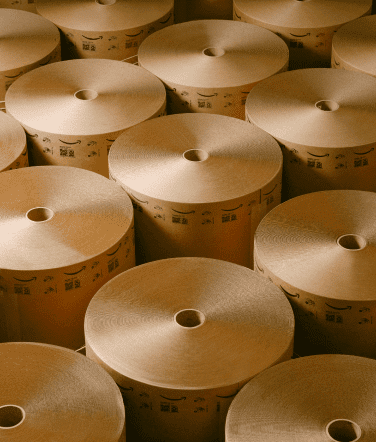
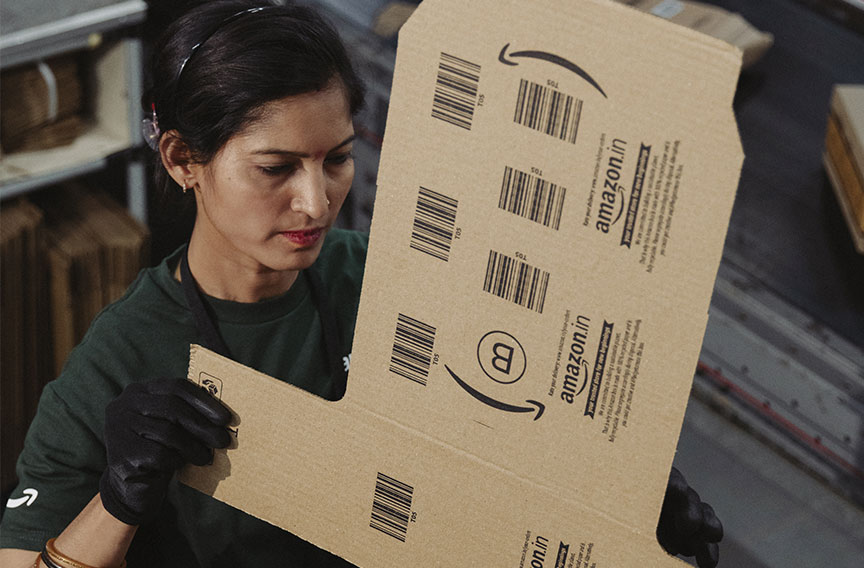
Our customers want right-sized, recyclable packaging that minimizes waste and ensures damage-free delivery. As we work to eliminate unnecessary packaging, we’re optimizing the type, material, and weight of additional packaging when it’s needed to deliver products safely. We’re also increasing the recyclability of our packaging to make recycling easy for our customers.
28Munique products certified for the Ships in Product Packaging program globally
5.4Mmetric tons of packaging materials avoided in North America and Europe since 2015
288Msingle-use plastic bags avoided from automated packaging machines across North America fulfillment centers
Our approach
Amazon delivers millions of packages every day, and we prioritize getting orders into the hands of our customers as quickly, safely, and with the least amount of packaging possible. Using a science-based approach, we strive to provide right-sized, recyclable, and scalable packaging solutions that reduce waste.
Our packaging strategy is guided by ongoing learning and innovation, and rooted in four pillars:
Avoid: We avoid additional packaging whenever possible by shipping products in their original packaging.
Optimize: When we need to use supplemental packaging, we prioritize lighter, right-sized options and use artificial intelligence to identify additional optimization opportunities.
Transform: We prioritize materials that are household recyclable and reduce single-use plastic packaging.
Innovate: We work across the public and private sectors to create and scale more sustainable packaging solutions and improve recycling infrastructure globally.
Machine learning
We use machine learning algorithms to determine the most efficient packaging for each order we fulfill. Machine learning algorithms also help us determine the best fit for orders with multiple items, so we can decrease empty space in boxes. Optimized shipments require less space in the vehicles that deliver packages to our customers, helping reduce the number of vehicles on the road.
Eliminating packaging
We strive to keep our packaging lightweight and minimal while ensuring deliveries reach customers without damage.
[01]
Sometimes the best solution is to use what already exists. Through our SIPP program, eligible items are delivered in the original manufacturer’s packaging without additional Amazon packaging. This allows us to avoid unnecessary packaging altogether and reduce the weight of deliveries. We’re expanding this program by identifying, evaluating, and certifying items already packaged in materials suitable for shipping. We also encourage selling partners and vendors to re-engineer packaging to meet SIPP standards.
11%of packages globally shipped without additional Amazon packaging in 2025
28Munique products certified for SIPP globally
To ensure groceries ordered from Amazon Fresh and Whole Foods Market arrive in good condition, we look for ways to protect products during delivery while minimizing our packaging footprint. For example, daily variable insulation is a practice that tracks and adjusts the amount of insulation packaging used in deliveries in North America to ensure it's used only when temperatures exceed a specific threshold.
51Mcheckout bags avoided in North America in 2025 through the introduction of stronger paper bags at checkout, reducing the need for double bagging
Reducing plastics
We're working to reduce our use of plastic for easily recyclable alternatives. We're also working on innovations and solutions to avoid single-use plastics.
Explore global highlights
Europe
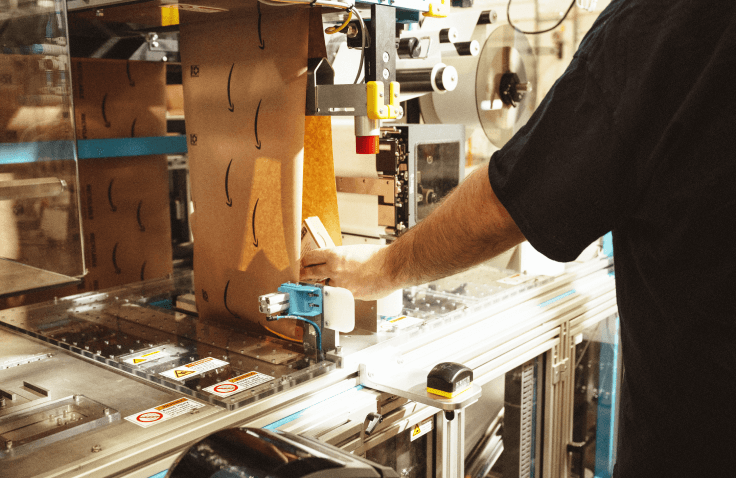
Beginning in 2025, we installed automated packaging machines in European fulfillment centers that create custom-sized cardboard boxes and paper bags in real time, precisely matching packaging to each item, avoiding excess material. In 2023, we announced that 100% of delivery packaging in Europe—the boxes, bags, and envelopes needed to get products to customers—was household recyclable, including for items sold by Amazon and third-party selling partners that use Fulfillment by Amazon.
India
100% of delivery packaging material is household recyclable in India as of the end of 2023.
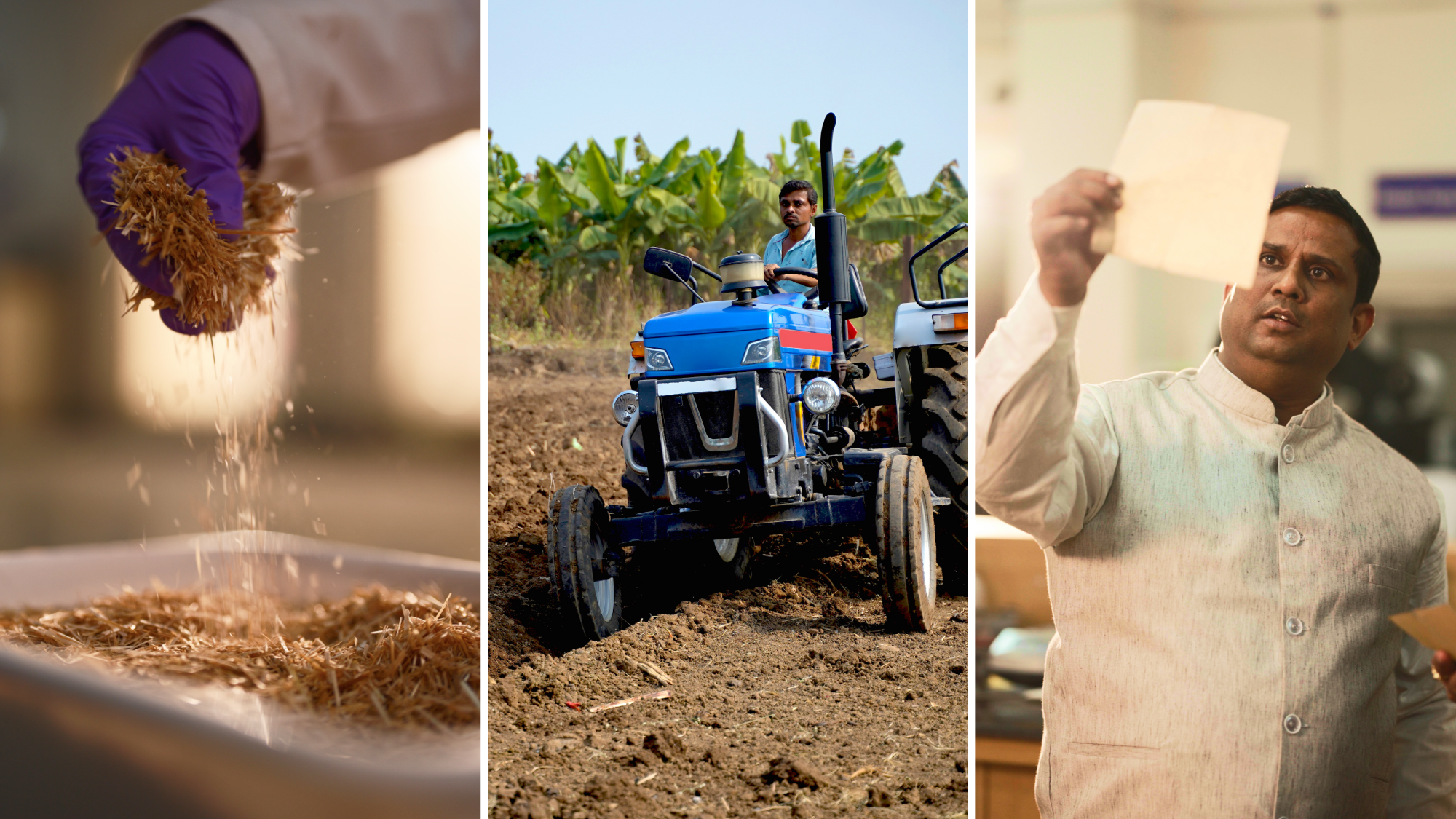
To explore innovative packaging solutions in India, Amazon and the Indian Institute of Technology (IIT) Roorkee are collaborating to turn agricultural waste into high-quality paper mailers. IIT Roorkee’s processes crop waste into a usable pulp, which is then washed and strained through a screen to remove impurities and maintain consistent quality. After a pressing and drying process, the resulting paper is ready for manufacturing into paper mailers that meet our durability and recyclability specifications.
Japan
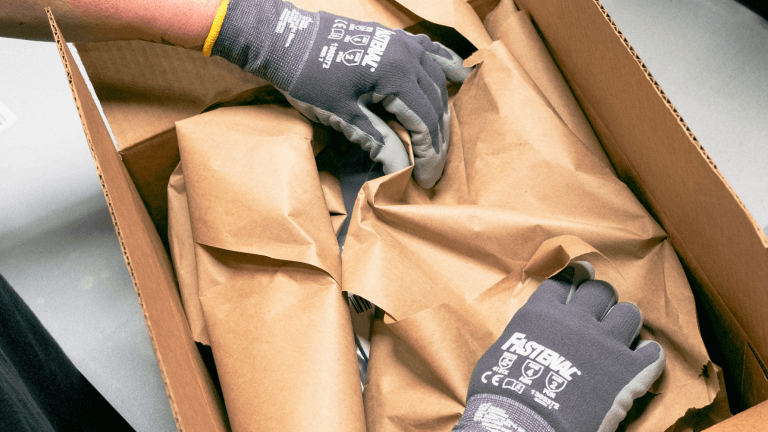
In 2025, we started rolling out a 54% smaller shipping label for small ship packages in Japan, reducing overall adhesive and paper use by 6%. As of the end of 2023, 99.5% of delivery packaging material is household recyclable. That year, we removed plastic shrink-wrap film and replaced plastic cushioning materials, such as air pillows, with paper-based dunnage in Japan, except when packaging fragile items and gift packages. We're also in the process of switching from plastic packaging tape to paper tape.
Brazil
We have significantly reduced the use of dunnage in our shipments. When we still need to secure products during shipping, we use paper-only dunnage, and we continue to increase our use of packaging made with recycled materials.
Egypt
We stopped using dunnage, including air pillows, in most boxes. When we do still need to use dunnage to secure products during shipping, we’re increasing our use of packaging made with recycled materials. For larger shipments that require dunnage, we are working toward replacing air pillows with paper alternatives.
Mexico
We stopped using dunnage, including air pillows, in most boxes. When we do still need to use dunnage to secure products during shipping, we’re increasing our use of packaging made with recycled materials. For larger shipments that require dunnage, we are working toward replacing air pillows with paper alternatives.
Saudi Arabia
We stopped using dunnage, including air pillows, in most boxes. When we do still need to use dunnage to secure products during shipping, we’re increasing our use of packaging made with recycled materials. For larger shipments that require dunnage, we are working toward replacing air pillows with paper alternatives.
United Arab Emirates
We stopped using dunnage, including air pillows, in most boxes. When we do still need to use dunnage to secure products during shipping, we’re increasing our use of packaging made with recycled materials. For larger shipments that require dunnage, we are working toward replacing air pillows with paper alternatives.
North America
In North America in 2025, we avoided 288 million plastic bags, and 56% of fulfillment centers in North America did not ship plastic delivery packaging. As a result, we saw a significant year-over-year decrease in the number of shipments that contained single-use plastic delivery packaging in North America. This means that, in 2025, 73% of shipments in North America were recyclable in household waste streams, up from 63% in 2024.
Spain
In 2024, we began early-stage testing on bio-based bags made from organic sources with Amazon Fresh in Spain. These bio-based bags have the best attributes of conventional plastic and paper, in that they are easily recyclable, biodegradable, lightweight, and have both water and oxygen barriers. Through this testing, we confirmed that these bio-based bags can be used for several harder-to-recycle, fossil fuel-based plastic applications.
Europe
Beginning in 2025, we installed automated packaging machines in European fulfillment centers that create custom-sized cardboard boxes and paper bags in real time, precisely matching packaging to each item, avoiding excess material. In 2023, we announced that 100% of delivery packaging in Europe—the boxes, bags, and envelopes needed to get products to customers—was household recyclable, including for items sold by Amazon and third-party selling partners that use Fulfillment by Amazon.
India
100% of delivery packaging material is household recyclable in India as of the end of 2023.
To explore innovative packaging solutions in India, Amazon and the Indian Institute of Technology (IIT) Roorkee are collaborating to turn agricultural waste into high-quality paper mailers. IIT Roorkee’s processes crop waste into a usable pulp, which is then washed and strained through a screen to remove impurities and maintain consistent quality. After a pressing and drying process, the resulting paper is ready for manufacturing into paper mailers that meet our durability and recyclability specifications.
Japan
In 2025, we started rolling out a 54% smaller shipping label for small ship packages in Japan, reducing overall adhesive and paper use by 6%. As of the end of 2023, 99.5% of delivery packaging material is household recyclable. That year, we removed plastic shrink-wrap film and replaced plastic cushioning materials, such as air pillows, with paper-based dunnage in Japan, except when packaging fragile items and gift packages. We're also in the process of switching from plastic packaging tape to paper tape.
Brazil
We have significantly reduced the use of dunnage in our shipments. When we still need to secure products during shipping, we use paper-only dunnage, and we continue to increase our use of packaging made with recycled materials.
Egypt
We stopped using dunnage, including air pillows, in most boxes. When we do still need to use dunnage to secure products during shipping, we’re increasing our use of packaging made with recycled materials. For larger shipments that require dunnage, we are working toward replacing air pillows with paper alternatives.
Mexico
We stopped using dunnage, including air pillows, in most boxes. When we do still need to use dunnage to secure products during shipping, we’re increasing our use of packaging made with recycled materials. For larger shipments that require dunnage, we are working toward replacing air pillows with paper alternatives.
Saudi Arabia
We stopped using dunnage, including air pillows, in most boxes. When we do still need to use dunnage to secure products during shipping, we’re increasing our use of packaging made with recycled materials. For larger shipments that require dunnage, we are working toward replacing air pillows with paper alternatives.
United Arab Emirates
We stopped using dunnage, including air pillows, in most boxes. When we do still need to use dunnage to secure products during shipping, we’re increasing our use of packaging made with recycled materials. For larger shipments that require dunnage, we are working toward replacing air pillows with paper alternatives.
North America
In North America in 2025, we avoided 288 million plastic bags, and 56% of fulfillment centers in North America did not ship plastic delivery packaging. As a result, we saw a significant year-over-year decrease in the number of shipments that contained single-use plastic delivery packaging in North America. This means that, in 2025, 73% of shipments in North America were recyclable in household waste streams, up from 63% in 2024.
Spain
In 2024, we began early-stage testing on bio-based bags made from organic sources with Amazon Fresh in Spain. These bio-based bags have the best attributes of conventional plastic and paper, in that they are easily recyclable, biodegradable, lightweight, and have both water and oxygen barriers. Through this testing, we confirmed that these bio-based bags can be used for several harder-to-recycle, fossil fuel-based plastic applications.
Improving recyclability
We’re innovating packaging materials for easy customer recycling, and phasing out padded bags containing plastics in favor of recyclable alternatives. We partner with industry peers and expert organizations, such as the Sustainable Packaging Coalition, to improve recycling infrastructure.
99.7%
of mixed-material mailers, which contain both plastic and paper, replaced with recyclable paper alternatives in the U.S and Canada
100%
of packaging material in Europe and India is household recyclable
100%
of outbound plastic delivery packaging was replaced with 100% household-recyclable paper filler at Amazon’s first U.S. automated fulfillment center, in Euclid, Ohio
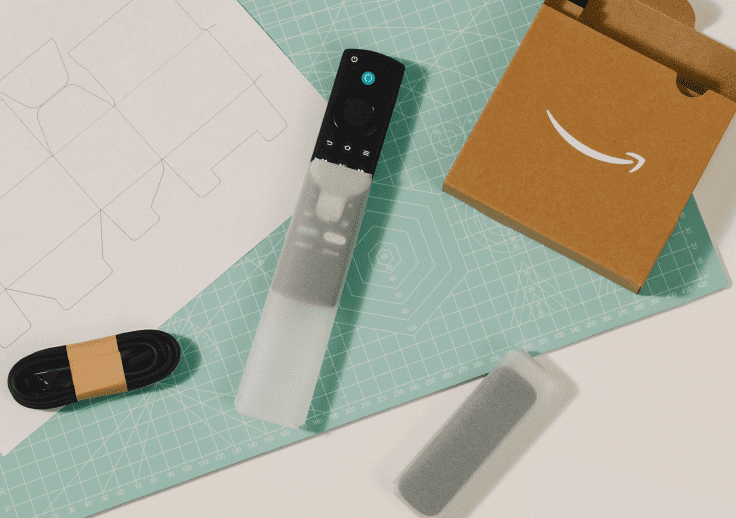
Our strategy to optimize and increase the recyclability of packaging extends to our devices. We remain committed to using recyclable device packaging and to inventing recyclable solutions for heavier items that properly protect the device while maintaining our high bar for quality.
A stronger, stretchier kind of paper is helping to reduce plastic across Amazon's packaging network--and boosting efficiency while working to prevent waste.
If you are a small business wanting to sell products across Europe, you face a complex web of packaging compliance requirements. We commissioned independent research to explore the real-life experience of an Amazon seller going through the entire registration process in 10 EU countries.

.jpg/jcr:content/renditions/cq5dam.web.1280.1280.jpeg)

.jpg/jcr:content/renditions/cq5dam.web.1280.1280.jpeg)
.png)